Personally, I think that tabs are a lot easier to read (and write) than notes once you get used to the format, and it's a very simple design.
You will see 6 lines representing the 6 strings. The layout of the lines are done so they match the strings if you look down at them while holding your guitar. If you lay your guitar on your lap, the bottom string (closest to your belly) is the thickest string (E), and the top string (closest to your knees) is the thinnest string (also E). That's the way the lines are shown for tabs. From the bottom up: E, A, D, G, B, E.
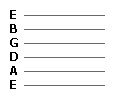
To represent where to place the fingers on the strings, you place the fret number on the line. A zero represents a string being played without placing a finger on it. Therefore, if you see zero's on all 6 lines, it means that you simply play all 6 strings without using your "fret-hand". You read the numbers from left to right, and if multiple numbers are placed above eachother, it means that you have to play them at the same time.
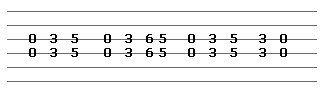
Here's a small example where you have to play the 2 middle strings simultaneously. It's the easy way of playing the intro to Smoke on the Water with Deep Purple:
more... (to come)